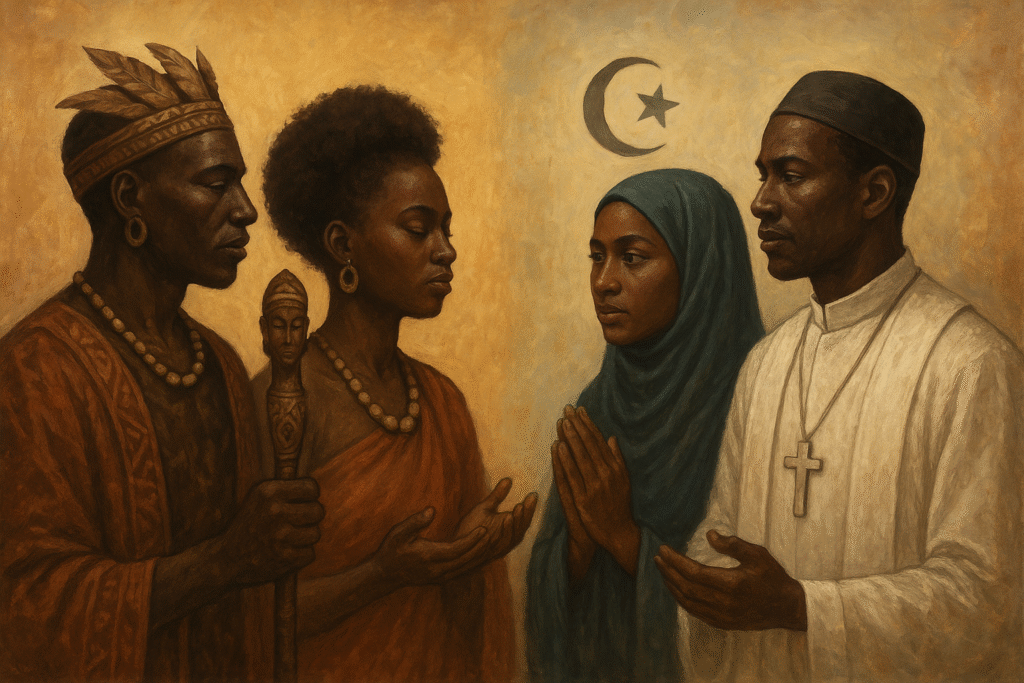
For centuries, Africa has been described as the most religious continent in the world. Mosques call the faithful to prayer at dawn, church choirs raise their voices on Sundays, and traditional shrines still sit quietly in villages where ancestors are honored. But behind this vibrant spiritual life lies a tension: the clash between indigenous African spirituality and imported organized religions like Christianity and Islam.
Is this clash inevitable, or can these spiritual systems coexist in shaping Africa’s future identity
The Roots of African Spirituality
Before Christianity and Islam took hold, Africa was home to diverse spiritual systems deeply tied to nature, ancestors, and community. From the Yoruba Ifá divination system in Nigeria, to the Akan traditions in Ghana, to Zulu ancestral rites in South Africa, spirituality was not separate from life it was life itself.
African spirituality emphasized:
Connection to ancestors as guardians and intermediaries.
Reverence for nature — rivers, trees, and mountains were sacred.
Community-based morality rather than rigid doctrines.
Balance and harmony rather than sin and punishment.
This worldview celebrated diversity and fluidity. Yet it would later be labeled “pagan,” “primitive,” or even “satanic” by colonial missionaries.
The Arrival of Organized Religion
Islam entered Africa as early as the 7th century through trade routes in North and East Africa. Christianity followed centuries later, spreading rapidly during colonialism. Missionaries brought schools, hospitals, and literacy, but also condemned African traditions as demonic.
By the 20th century, organized religions dominated much of Africa. Today, about 85% of Africans identify as either Christian or Muslim, with indigenous religions often surviving in secrecy or syncretism.
The Clash: Faith or Erasure?
The tension lies in how organized religions positioned themselves not as partners, but as replacements. African deities were demonized, rituals outlawed, and sacred knowledge dismissed as superstition. Converts were encouraged to abandon ancestral practices and adopt foreign names, clothing, and belief systems.
This clash was not just spiritual but cultural. To reject African spirituality often meant rejecting African identity itself. In many communities, shame and stigma still surround traditional practices, pushing them underground.
The Case for Coexistence
Yet, African spirituality never disappeared. Instead, it adapted. Many Africans today blend faiths, attending church on Sunday while consulting traditional healers during crises. Some Muslims in Senegal still visit marabouts (spiritual leaders) who draw from indigenous wisdom.
This syncretism shows that African spirituality and organized religion need not be enemies. Instead, they can coexist — if both are respected. For instance:
Healing practices from traditional systems complement modern medicine.
Ancestral respect enriches Christian and Islamic teachings on family.
Environmental reverence aligns with modern ecological concerns.
The Global Resurgence of African Spirituality
Ironically, while African spirituality is often stigmatized on the continent, it is experiencing a revival globally. From the popularity of Yoruba Ifá in Brazil and Cuba, to African Americans embracing ancestral practices as part of cultural reclamation, African spirituality is being revalued abroad.
This raises a powerful question: why is Africa so quick to abandon what the world is beginning to celebrate?
Organized Religion’s Benefits and Blind Spots
It would be unfair to dismiss Christianity and Islam as purely destructive. They have inspired movements for justice, education, and nation-building. Churches and mosques are pillars of social life, providing hope and community.
But they also carry blind spots. When rigid dogma silences dialogue, when “foreign” spirituality is equated with evil, and when religion becomes a political weapon, Africa loses part of its soul.
The Path Forward: Reconciliation
To move forward, Africa may need to embrace spiritual plurality instead of forced hierarchy. This means:
Recognizing African spirituality as a legitimate system, not a relic.
Creating interfaith dialogues that include indigenous voices.
Teaching African heritage in schools, alongside world religions.
Encouraging personal freedom to choose or combine faiths without stigma.
Such reconciliation is not just about spirituality, but about healing Africa’s cultural wounds from colonialism.
African spirituality vs. organized religion is not just a theological debate,it is a battle over identity, memory, and self-determination. To dismiss indigenous practices as backward is to dismiss Africa’s wisdom, resilience, and creativity.
True freedom lies in reclaiming balance. Africans should not be forced to choose between church, mosque, or shrine. Instead, they should be free to walk all three paths or forge new ones without shame.
Because at the heart of both African spirituality and organized religion is the same search: the search for meaning, harmony, and connection. And perhaps, if respected equally, they can help Africa find not only God, but also itself.