Rediscovering Africa Before the Chains: An Exclusive Conversation with Hyenmen Joseph Nyam
Hyenmen Joseph Nyam is not just a historian he is a cultural seer. A thinker and storyteller with a burning passion to restore Africa’s true identity, Nyam’s voice echoes across time, awakening a continent long told to forget its greatness.
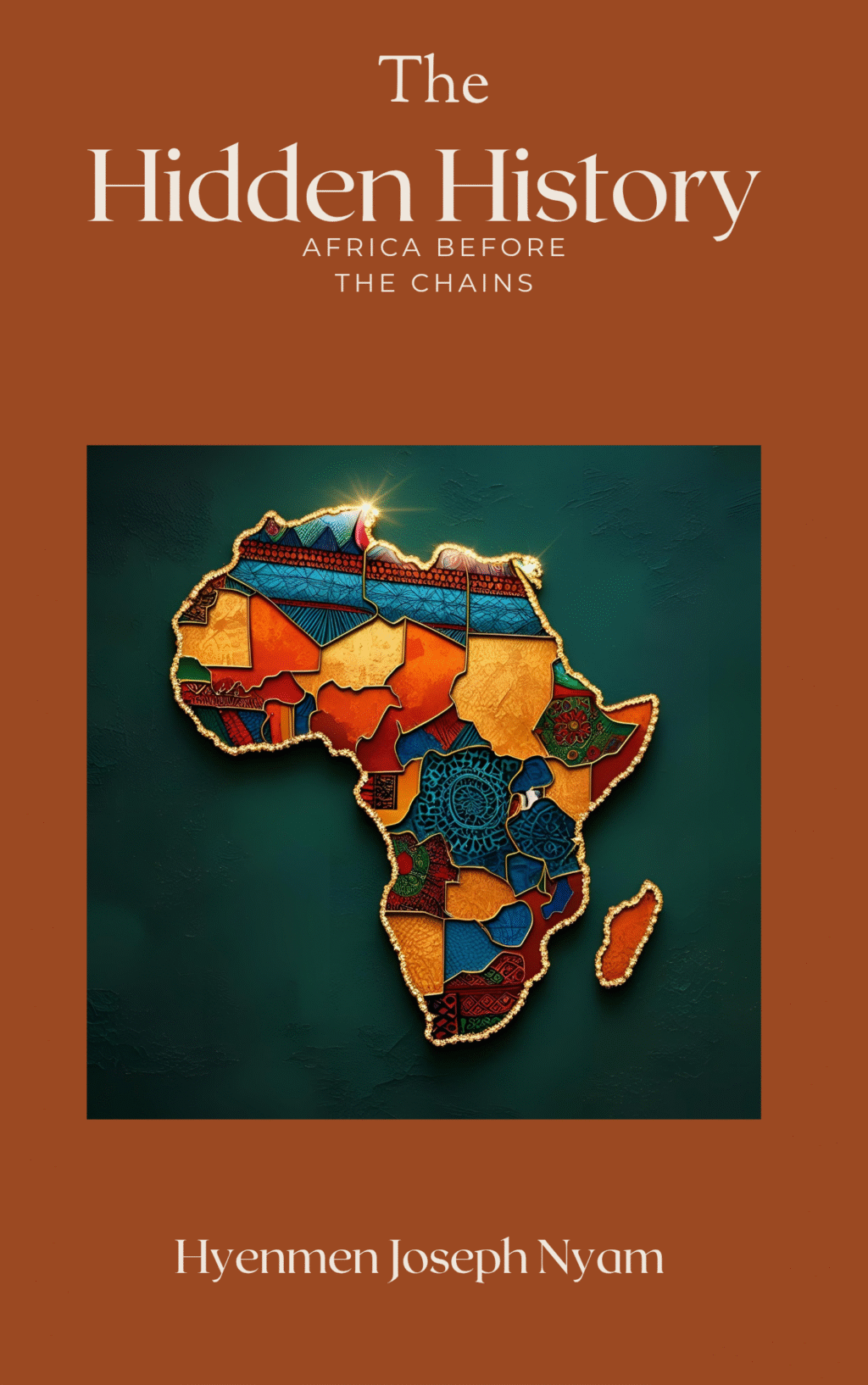
In his groundbreaking book, The Hidden History: Africa Before the Chains, he dismantles colonial myths and reveals a deeper truth, one where Africa stands not as a land of lack, but as the cradle of civilization, governance, innovation, art, and human brilliance.
At Ajoke Brown Media, we believe in amplifying voices that reclaim Africa’s light. Nyam’s work does exactly that. This is not just a book it is memory reborn, identity reclaimed, and power rediscovered.
As Africa steps into a new era of self-definition, The Hidden History reminds us that the key to progress lies in remembering who we are. Because Africa’s story is not one of struggle alone, it is a symphony of resilience, beauty, and brilliance that once shaped the world and will again.

What inspired you to write The Hidden History, and why was now the right time?
I’ve always been troubled by a question that lingers in many African hearts: how can a land so rich, so blessed, remain so broken?
We hold the world’s most fertile lands, the minerals that power its industries, and the resources that sustain its luxury yet Africa remains marginalized.
There had to be a reason. I began tracing the roots of this imbalance not just politically or economically, but spiritually and historically. That search birthed The Hidden History. It is both a revelation and a restoration. I wanted to tell the truth about who we were before the world rewrote our story.
When you imagine Africa before colonialism, what image do you wish the world could see?
I want the world to see Africa as she truly was the Mother of the World.
A continent of empires, scholars, builders, astronomers, traders, and philosophers. We had complex systems of governance, education, and technology long before colonialism.
But to take what they wanted, they first had to dismantle what we built. They tore down our kingdoms, renamed our landmarks, and buried our wisdom yet, they still depend on us. That dependence speaks volumes about the magnitude of Africa’s greatness.
Which aspects of pre-colonial Africa are most overlooked in mainstream history?
The sheer sophistication of our civilizations. Africa was never primitive it was purposeful.
Our ancestors built cities with architectural mastery, cultivated trade routes that connected continents, and established philosophies that valued community over conquest.
The silence around these achievements wasn’t accidental, it was strategic. To dominate us, they had to erase our confidence. But once we reclaim that knowledge, once we understand who we are and what we carry, we’ll realize Africa has always had the power to sustain the world.
Western narratives often portray Africa through a narrow lens. How does your work challenge that?
Our natural resources power the very devices people use to talk about Africa. Our gold, our diamonds, our oil they fund empires. Even the British Crown wears stones from African soil.
Yet, they omit our contributions. The walls of the Benin Kingdom, for instance, stretched farther than the Great Wall of China. The pyramids of Sudan outnumber those of Egypt. These facts were erased from the curriculum and replaced with tales of savagery.
The Hidden History restores that stolen glory. It reminds the world and ourselves that we are not beggars in history, we are its architects
How has the distortion of African history affected the continent’s self-image?
For generations, Africa was conditioned to see itself through a foreign lens as a supplier, not a creator. We were taught that salvation lies abroad, that progress wears Western clothes. But today, we know better. The illusion is breaking. A new consciousness is rising one rooted in truth.
What role do art, culture, and tradition play in preserving this legacy?
Art, culture, and tradition are the veins through which Africa’s spirit flows.
Our hairstyles, our music, our food, our patterns these are living archives of our identity. The world still treasures our artifacts in foreign museums and imitates our style in pop culture.

If the world sees value in our heritage, how much more should we? We must preserve and protect these treasures, for they carry the rhythm of who we are.
How do you hope your book influences younger Africans, both at home and abroad?
This book is a mirror, a reminder to every young African that greatness runs in their blood.
When you know your origin, you no longer doubt your worth. You walk differently. You lead differently. You create differently. Understanding our true history gives us the confidence to innovate and lead on our own terms.
How can knowledge of history become a tool for modern progress?
History is not nostalgia it’s strategy. When you know where you come from, you understand what makes you unique. That uniqueness is power. It’s what drives innovation, leadership, and creativity. The future belongs to those who remember.
Why is Africa’s past described as “hidden,” and who benefits from that concealment?
It was hidden so we would doubt ourselves. Once a people forget their greatness, they surrender it. Those who concealed our truth benefit from our ignorance they take our resources, our ideas, our talents, while convincing us we have none. The Hidden History breaks that cycle.
How can spirituality, creativity, and community drive Africa’s modern rebirth?
Africa’s spirituality is the heartbeat of her creativity. It connects us to the unseen, to purpose, to one another. When we honor that connection, our art deepens, our innovation aligns, and our rebirth becomes inevitable. The new Africa will not copy it will create
If you could highlight one civilization every reader should know about, which would it be?
The Benin Empire a masterpiece of organization, artistry, and diplomacy.
Its walls, art, and governance prove that Africa’s pre-colonial societies were anything but “primitive.” They were models of balance between leadership and spirituality, technology and nature, power and purpose.
What can today’s African leaders learn from our ancestors?
They must lead with heart. Our ancient leaders governed to nurture the community, not exploit it.
If today’s leaders rediscover that principle to trade fairly, process our own resources, and lift one another, Africa will rise again, not as a charity case, but as a global force of purpose and prosperity
How do you respond to those who say history belongs in the past?
If you abandon your history, you gamble with your destiny.
History is the foundation on which the future stands. To know where we’re going, we must first know who we’ve been.
What message do you want readers to carry after turning the final page?
That we come from empires. From visionaries, healers, builders, and dreamers.
That greatness has not left us it lives within us. The chains were external; the power was always internal. Once we remember that, the sky will not be our limit — it will be our beginning.
Where can readers find The Hidden History: Africa Before the Chains?
You can grab your copy on Amazon at https://www.amazon.com/dp/B0FR28NF8J.
Paperback and hardcover editions will be available soon, alongside future works that continue this mission of truth and restoration.
About the Author
Hyenmen Joseph Nyam is a cultural thinker, historian, and storyteller dedicated to restoring Africa’s authentic narrative. Through The Hidden History: Africa Before the Chains, he challenges mainstream narratives and invites readers to rediscover the continent’s legacy of innovation, governance, spirituality, and resilience.
His work is more than history it is a call to remembrance, a spiritual awakening, and a vision for a united Africa built on pride, purpose, and possibility.