The agricultural landscape of the African continent has become a high-stakes battleground for the future of sustenance, sovereignty, and science. As climate change accelerates unpredictable weather patterns, prolonged droughts, and aggressive pest infestations, African nations find themselves at a historic crossroads.
On one side, biotechnology agencies and corporate conglomerates champion genetically modified (GM) seedlings as vital, high-yielding weapons against hunger. On the other side, an escalating coalition of smallholder farmers, environmental activists, and civil society groups warn that introducing these laboratory-engineered crops invites an impending ecological and economic crisis.
This extensive investigative feature by Ajoke Brown Media pulls back the corporate curtain on Genetically Modified Organisms (GMOs) in Africa. We explore the science behind the seedlings, lean into the explosive controversies regarding food sovereignty, and unpack the deep-seated public health and financial fears echoing from smallholder farms to regional parliaments.
The Modified Seedlings: Scientific Promise vs. Agrarian Tradition
To understand the friction surrounding GMOs in Africa, one must look directly at the specific seeds driving the current narrative. The two most prominent genetically modified varieties currently saturating West African discourse are TELA Maize and PBR (Pod Borer Resistant) Cowpea
TELA Maize: Engineered to resist drought and specific insects like the devastating Fall Armyworm.
PBR Cowpea: Modified with a gene from the soil bacterium Bacillus thuringiensis (Bt) to protect the crop against the Maruca vitrata pod borer pest.
The Self-Pesticide Debate
Advocacy bodies such as the Health of Mother Earth Foundation (HOMEF) raise severe environmental and biological alarms regarding this technology. Activists argue that modifying a plant to internally produce its own insecticidal toxins essentially transforms the food crop itself into a living pesticide.
When a crop continuously expresses toxins to repel pests, it does not just target the destructive insects; it introduces heavy ecological pressure that can eradicate non-target beneficial insects, disrupt localized biodiversity, and accelerate the evolution of “super-bugs” that develop rapid immunity to the modified traits.
The Threat to Indigenous Genetic Purity
For centuries, traditional African farming systems have relied on seed-saving practices, the sacred tradition of selecting, storing, and replanting indigenous seeds handed down through generations. These native varieties possess localized, evolutionary resilience built over millennia.
The introduction of commercialized GM fields threatens this ancestral biodiversity through inevitable cross-pollination. Wind, birds, and insects do not respect farm boundaries. When pollen from genetically modified crops drifts into adjacent organic or indigenous farms, it permanently alters the genetic makeup of native crops. Critics warn that this biological contamination could lead to the gradual extinction of pure, indigenous African seed varieties, leaving our agricultural ecosystem completely dependent on laboratory-created strains.
The Sovereignty Controversy: Foreign Corporate Dominance and Neo-Colonialism
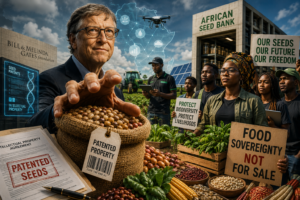
At the heart of the anti-GMO movement is the fundamental question of seed sovereignty: Who controls the food supply of Africa? Major global biotechnology cartels aggressively push patented seeds into the African market, sparking fierce debates over what critics label corporate neo-colonialism.
The Trap of Proprietary Patents
Traditional African farming is built on cyclical independence. A farmer harvests, saves a portion of their yield, and replants the following season without spending capital on new seeds.
Proprietary, genetically modified seeds completely break this sustainable loop:
Traditional Farming ──> Harvest ──> Save Seeds ──> Replant (Free & Sovereign) GMO Farming Loop ──> Harvest ──> Cannot Save ──> Buy New Patented Seeds + Chemicals Every Season
Because GMO seeds are heavily protected by international patent laws, farmers are legally prohibited from saving and replanting them. F2 generation seeds from hybrid or modified crops also frequently suffer from severe yield depreciation if replanted. This forces smallholder farmers into a permanent, expensive loop of purchasing seeds and specialized synthetic chemical pairs from foreign multinational corporations every single season. It transforms independent food producers into dependent consumers of foreign biotechnology.
Global Ideological Divides
The approach to agricultural biotechnology across the African continent is deeply fragmented, reflecting a massive ideological split:
| Nation | Current GMO Regulatory Stance | Key Agricultural Focus |
| Nigeria | Aggressively Commercializing | Open adoption of TELA Maize and PBR Cowpea to maximize mass industrial yields. |
| Kenya | Highly Fluid / Contested | Alternating between bans and lifting restrictions amid intense legal and public battles. |
| Burkina Faso | Strict Rejection / Reversal | Phased out Bt Cotton due to quality degradation; heavily shifting focus toward organic agroecology. |
| Zimbabwe | Outright Cultivation Ban | Strictly prohibits the cultivation of GM crops to protect local biodiversity and export purity. |
Burkina Faso’s historical pivot away from Bt Cotton serves as a warning flag for many African nations. While initial yields were high, the long-term quality of the lint deteriorated, damaging the country’s premium textile reputation. Today, a growing block of African agronomists look to states like Zimbabwe as practical blueprints, arguing that prioritizing indigenous agroecology rather than corporate biotechnology is the only authentic path to food security.
Public Fears and Regulatory Blind Spots
While state-backed regulatory agencies, such as Nigeria’s National Biotechnology Research and Development Agency (NBRDA), continuously issue public assurances that commercialized GM crops are entirely safe for human consumption, public skepticism remains exceptionally high.
Chronic Healthcare Infrastructure Concerns
Opponents emphasize that comprehensive, long-term epidemiological studies on the human health impacts of a strictly GMO-based diet are vastly insufficient. The primary concern is not acute toxicity, but rather chronic risks:
The potential creation of new, unexpected allergen mutations within the human digestive system.
The long-term impact of consuming crops engineered with antibiotic-resistant marker genes, which critics fear could exacerbate localized antibiotic resistance.
In Western nations, rigorous public health monitoring and advanced laboratory tracking exist to spot anomalies in food supplies. Contrastingly, African healthcare infrastructures are already heavily overburdened. If chronic illnesses or obscure auto-immune conditions stem from altered dietary proteins over a twenty-year period, local health systems lack the diagnostic profiling capacity to trace, isolate, and address those systemic failures.
The Open-Air Market Transparency Crisis
The greatest point of vulnerability regarding GMOs in Africa lies within the informal supply chain. In Western markets, strict regulatory frameworks ensure that genetically modified foods are explicitly labeled, offering consumers a democratic choice.
In African marketplaces, this transparency breaks down entirely:
GMO Harvest ──> Open-Air Market Baskets ──> Sold Loose by Measure ──> Total Loss of Consumer Choice
Because the vast majority of food staples move through informal, open-air markets, grain is poured into shared basins, mixed, and sold loose by measure. When food is distributed informally, mandatory packaging and labeling regulations become physically impossible to enforce. Millions of African consumers are buying, cooking, and feeding genetically modified ingredients to their families every single day without their knowledge, awareness, or explicit consent.
The Path Forward: Agroecology and True Food Independence
True food security cannot be bought or imported via proprietary corporate patents. To build a resilient African agricultural future in the face of climate change, the continent must invest in agro ecological innovation rather than corporate dependencies.
Strengthening Community Seed Banks: Governments and regional agricultural blocks must fund localized networks that preserve, optimize, and distribute high-yield, drought-resistant indigenous seed varieties.
Investing in Organic Pest Management: Rather than introducing internal plant toxins that disrupt ecosystems, resources should be poured into scaling natural pest-control systems, intercropping methodologies, and organic soil regeneration.
Enforcing Sovereign Policy Frameworks: Regional bodies must implement strict liability laws that protect smallholder farmers from genetic contamination caused by neighboring GM test fields.
Biotechnology presents a tempting, short-term fix to an incredibly complex socio-economic challenge. However, true agricultural power belongs to those who own their seeds. For Africa to feed itself tomorrow, it must protect its soil, guard its heritage, and resist the seductive trap of giving away its foundational independence to global corporate gatekeepers.